
Head Shape / Flat Head
Flat head syndrome is one of the most common and most treatable things I see, but only when families act early. This guide brings together everything I teach about why flat spots develop, how to check for them at home, and what to do at every age.
Why flat spots happen
"Flat head syndrome" is the umbrella term for Plagiocephaly, Brachycephaly, and Scaphocephaly. It is very common, with roughly half of babies showing some degree of flattening, and it is very treatable. The flattening comes from three different causes. Positional plagiocephaly is by far the most common: it is linked to extended periods spent lying in one position, such as in a baby seat or swing, or sleeping on the back as recommended by the Back to Sleep initiative, and it typically improves with repositioning and supervised tummy time. In-utero constriction happens when the skull is compressed in the womb due to limited space, often with multiples or unusual fetal positioning; it can cause flattening at birth but typically improves as the baby grows, early repositioning is started, and the baby develops more mobility. Craniosynostosis is a rare condition where one or more skull sutures fuse prematurely, preventing normal skull growth; it usually requires surgical intervention within the first year, which makes early diagnosis critical.
Head Shape · quick guide
Why flat spots happen
There are four primary atypical head shapes to understand. Plagiocephaly is flatness on one side of the head, with an anterior ear shift and protrusion of the forehead on the same side, often seen in babies with a rotation preference such as in torticollis. Brachycephaly is flatness across the entire back of the head, commonly seen in babies who spend excessive time in containers or use plagiocephaly pillows. The combined type is a mix of the two and is the most common. Scaphocephaly is flatness on the sides of the head, often associated with premature infants. The risk factors for head flatness include males, babies with torticollis, twins and multiples, NICU babies, babies delivered with instrumentation, and babies who spend too much time in containers. Premature babies are especially susceptible because the skull is so soft and malleable at that age, and I have seen many NICU babies develop right-sided plagiocephaly when positioning protocols keep them facing the same side. Since the Back to Sleep program began in 1994, SIDS has decreased, but torticollis and plagiocephaly have significantly increased. All atypical head shapes can impact development, because asymmetry that starts in the skull can extend to muscle imbalances in the neck, trunk, and pelvis.
How to check your baby's head at home
Head Shape · quick guide
How to check your baby's head at home
You can check your baby's head shape at home. Place your baby on their back and hold their head in neutral, then look at the head from a top-down angle. A good moment to check is during or after bath time, when the head is wet and the shape is easy to see. From above, look for the asymmetries: frontal bossing and a fuller cheek on one side, an ear shift, occipital bossing on the back, and any flat spot. Watch for these red flags early on: a neck rotation preference in the first four months, napping or sleeping on the same side of the head, difficulty with tummy time, facial asymmetry such as one eye more narrow, a flatter cheek, or an ear shift, and asymmetries in the arms like one arm always straight while the other is always bent. If you notice any amount of developing head flatness, do not wait and see. We can start correcting this as early as 2 to 3 weeks old with repositioning, stretches, strengthening exercises, and referrals if needed.
Prevention and repositioning
Repositioning is the gold standard and should be the first line of defense for head shape abnormalities. Done early and specifically, it can possibly eliminate the need for a helmet altogether or can minimize the time needed in a helmet if one becomes necessary. Noticing a flat spot can be stressful, but there is so much you can do before a helmet is even discussed. Here are the first things I look at: alternate feeding, changing, and holding sides; position back play so your baby looks toward their non-preferred side; limit time in containers; change your baby's head position during sleep to the non-flat side; and be assessed by an infant PT or OT for torticollis. Small daily changes can make a huge difference: reposition, rotate, and move often.
Head Shape · quick guide
Prevention and repositioning
Two myths slow families down, so let me be direct. Tummy time is essential, but it will not fix a flat head; it will only prevent it from getting worse, because the asymmetry needs an external force to correct. And do not waste your money on plagio pillows. They do not work.
The results of early repositioning can be dramatic. I have seen a visible head shape transformation in just one week, with even the missing patch of hair on the flattened side growing back. Another family went from a CVA of 11mm to 8mm and a CVAI of 8.9 to 6.2, moving from high-moderate to mild head shape with four weeks of correction still ahead. One baby improved noticeably in just two weeks using repositioning strategies, tummy time, symmetrical play, and parent handling techniques. Three helmet-free success stories all share the same key: the families started between 2 and 3 months, when repositioning and gentle PT make the biggest impact. The earlier we start, the more improvement we can see.
The torticollis connection
Head Shape · quick guide
The torticollis connection
One cannot check the neck without checking the head shape, and vice versa. Torticollis and plagiocephaly go hand in hand, and torticollis is the leading risk factor for flat head. As a simple example, a baby with a neck tilt to the right and a rotation preference to the left would correspond with a left-sided flattening. If you notice your baby has a flat spot or a preference to look in the same direction all the time, consult a PT as early as possible. Approximately half of babies have some form of plagiocephaly, and addressing these asymmetries earlier means less treatment time. Pediatric physical therapists should be the first line of defense for torticollis and plagiocephaly: if you notice head flattening or a neck rotation preference, let us get these babies referred before 3 months instead of waiting.
When to get help: the clock is ticking
This is the most important section of this guide. There is a widespread idea that flat head will correct itself, or that more tummy time alone will fix it. Mild cases may resolve on their own as your baby begins to roll and spend less time on their head, but moderate to severe cases will likely require skilled intervention, and a flat head will not reliably self-correct. Flat head is also common and very treatable, and it is not your fault as a parent.
Head Shape · quick guide
When to get help: the clock is ticking
The repositioning window is small, and that is why "wait and see" is so costly. The ideal time to work with your baby to reposition the head and avoid a helmet is 2 weeks to 2 months old, with the first four months being the repositioning window. Around 4 to 5 months repositioning may still be worth trying, and before the baby shows signs of rolling it remains an option, but once rolling starts the helmet is the better choice, and by 5 to 6 months a helmet is the best option. If we see these babies before 3 months, ideally by 1 month, we can often avoid a helmet and decrease PT treatment time. The problem is that most babies are not referred until 4 to 5 months, which is also the ideal time to be measured for a helmet if the case is moderate to severe. Four months is when most babies are referred to PT for plagiocephaly, and that is a good time to be referred, but it is not the best time if we want to reshape the head with repositioning. Your pediatrician may only see your baby three or four times before repositioning is no longer an option, and a wait-and-see approach misses the timeline. Please advocate for your baby the second you notice a head preference or a flat spot. Earlier treatment means less treatment time, fewer future complications, and a possible path around the helmet.
Helmets: what to know when repositioning is no longer enough
When a family receives a helmet report, the numbers can be confusing. Reports use measurements like CVA, CVAI, and CI to determine the need for a helmet, track how repositioning is going, and measure progress in your child's head shape journey. These numbers are based on research, not on the helmet company's own determination, and understanding them helps families make informed decisions.
Head Shape · quick guide
Helmets: what to know when repositioning is no longer enough
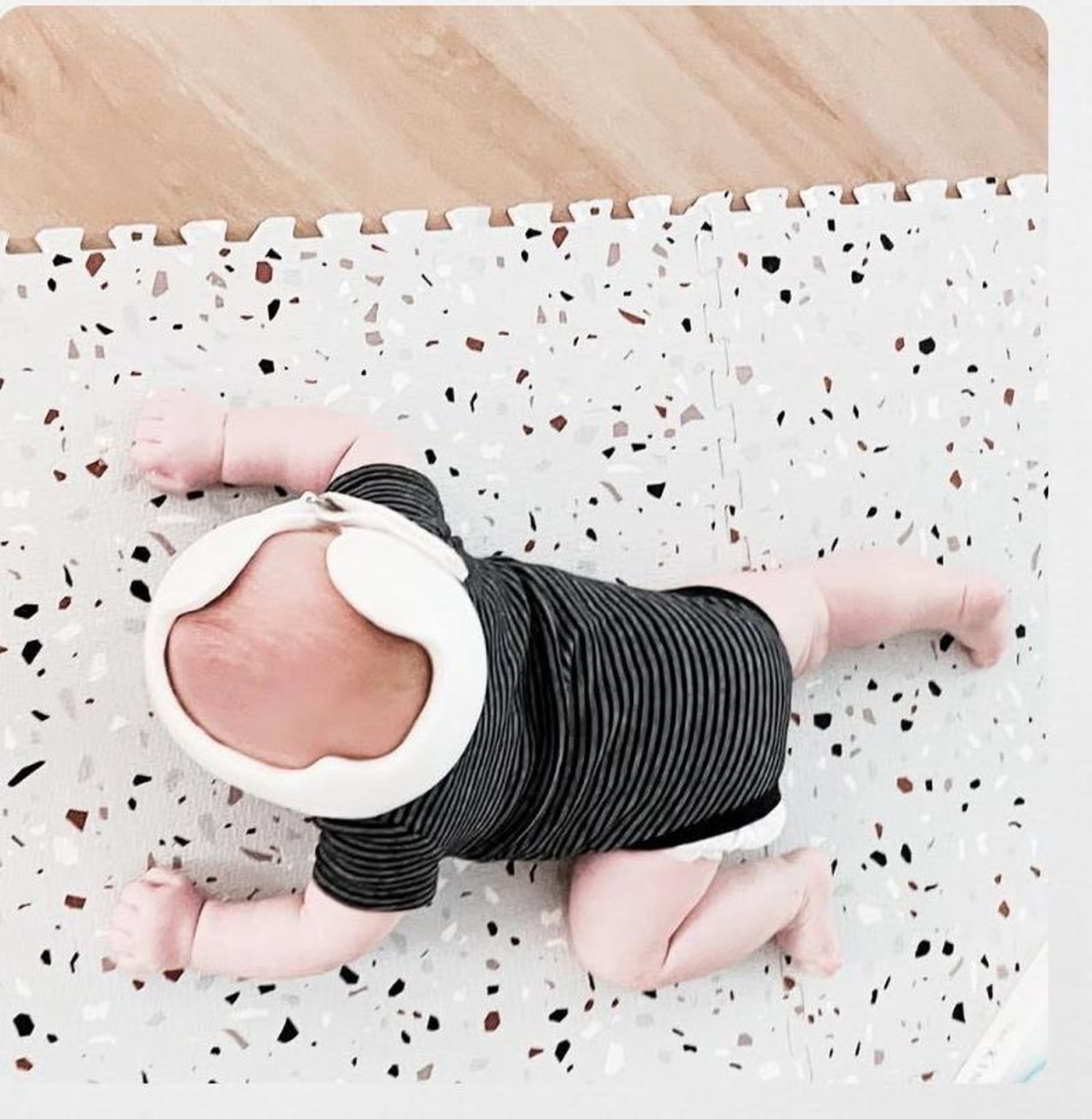
A helmet for infants is much more than a cosmetic accessory. It plays a vital role in reshaping the skull during crucial developmental stages by gently guiding the skull into a more symmetrical shape, which helps reset the baby's center of gravity. This allows for improved facial symmetry, ear symmetry, and overall head positioning within the foramen magnum, the large opening at the base of the skull where the spinal cord connects with the brainstem. When the back of the head is flat, the skull shifts forward in tummy time, and as the baby goes to lift their head, they hit a structural block. That is why they recruit their back muscles to help lift their head, and because the head is heavier in the front, they have to fight harder against gravity. A more symmetrical head shape encourages the infant to lift their head more centrally and engage their muscles properly. So an unaddressed flat head is not only cosmetic; it can sometimes contribute to developmental delays and poor alignment.
Here is what to know if your baby needs a helmet: it will need to be worn 23 hours a day, every day, for around 6 to 8 weeks depending on when it goes on, and you may need two if the case is severe. Babies tolerate helmets far better than we think. And please understand this: your baby needing a helmet is not a setback, it is a step forward. A helmet is not a sign that something went wrong; it is a tool to help your little one's head shape grow beautifully and evenly as they continue to hit milestones. Most babies adjust quickly, and before you know it, it just becomes part of their routine. This is a short chapter in a long, healthy story.